
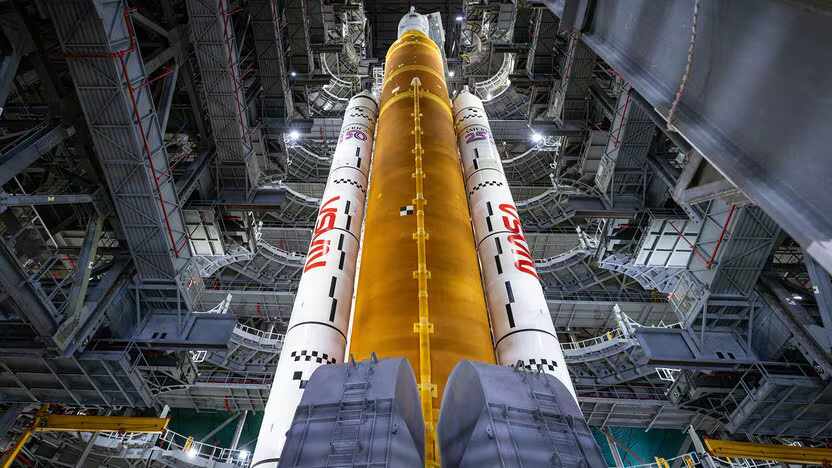

The world is on the brink of a historic moment in space exploration as NASA prepares to launch the Artemis II mission, the first crewed journey to the Moon in more than half a century. Scheduled for early April 2026, this mission is not just another spaceflight but a defining milestone that signals humanity’s return to deep space exploration after the Apollo era.
Artemis II will carry four astronauts aboard the Orion spacecraft, launched using the powerful Space Launch System rocket. The mission is designed as a 10-day journey that will take the crew farther from Earth than any human has traveled before, looping around the Moon and returning safely. This mission marks the first time humans will venture beyond low Earth orbit since 1972, making it one of the most anticipated space events in decades.
Unlike the Apollo missions, Artemis II is not focused on landing on the lunar surface. Instead, its primary objective is to test critical systems required for long-duration deep space travel. These include life support, navigation, communication, and thermal systems, all of which are essential for future missions. The data collected during this journey will play a crucial role in shaping upcoming missions, including Artemis III, which aims to land astronauts on the Moon later in the decade.
The mission will follow a “free-return trajectory,” meaning the spacecraft will loop around the Moon and naturally return to Earth without requiring extensive propulsion adjustments. This approach enhances safety while allowing astronauts to test spacecraft performance in deep space conditions. During the journey, the crew will conduct experiments and system checks while traveling hundreds of thousands of kilometers from Earth.
One of the most remarkable aspects of Artemis II is its diverse and historic crew. The team includes Commander Reid Wiseman, Pilot Victor Glover, Mission Specialist Christina Koch, and Canadian astronaut Jeremy Hansen. This mission will break multiple barriers, with Glover becoming the first person of color to travel around the Moon, Koch the first woman, and Hansen the first non-American to venture beyond low Earth orbit. These milestones highlight the global and inclusive nature of modern space exploration.
The Artemis program itself represents a long-term vision that extends far beyond a single mission. NASA aims to establish a sustainable human presence on the Moon, using it as a stepping stone for future missions to Mars. Artemis II is a critical part of this roadmap, demonstrating that humans can safely travel and operate in deep space for extended periods.
Preparation for the mission has been intense and meticulous. The Space Launch System rocket, one of the most powerful ever built, has undergone extensive testing and assembly at Kennedy Space Center in Florida. Engineers have spent years ensuring that every component meets the highest safety standards, reflecting the complexity and ambition of the mission.
Beyond its technical significance, Artemis II carries deep symbolic value. It represents humanity’s renewed ambition to explore beyond Earth and push the boundaries of what is possible. The mission also reflects growing international collaboration, with contributions from agencies like the Canadian Space Agency and the European Space Agency.
Public excitement around the mission is rapidly growing, with millions expected to watch the launch live. NASA has also engaged global audiences by allowing people to send their names aboard the spacecraft, creating a unique connection between the mission and the public. This level of engagement shows how space exploration continues to inspire people around the world.
As the countdown to launch begins, Artemis II stands as a powerful reminder of how far space technology has come and how much further it can go. It is not just a mission to orbit the Moon but a stepping stone toward a future where humans live and work beyond Earth.
In the end, Artemis II is more than a return to the Moon. It is the beginning of a new era in space exploration, where innovation, collaboration, and ambition come together to shape the next chapter of human history among the stars.
